Search This Blog

Showing posts with label attaching a table top. Show all posts

Tuesday, April 12, 2022

Woodworking Education: Tiny Table 1

Tiny Table 1

A Lesson in Wood Fabrication and Joinery

Teaching furniture design to college students who have no prior experience with fabrication techniques requires showing them examples of how to turn raw materials into finished furniture. 

Tiny Table is a final project for the beginning workshop class to teach them common wood table joinery. It also shows them all the steps needed to get from raw wood to finished parts that make up the table.  It is best to have students all work though the required steps to build their own version. It gives them motivation to do a nice job, and they end up with something they can use. In the process of making their own they also learn about the tools they will be using.  That and the typical joinery used as well as how to make the required joints.

The project is also a lesson about and demonstration showing the continuity of details possible.

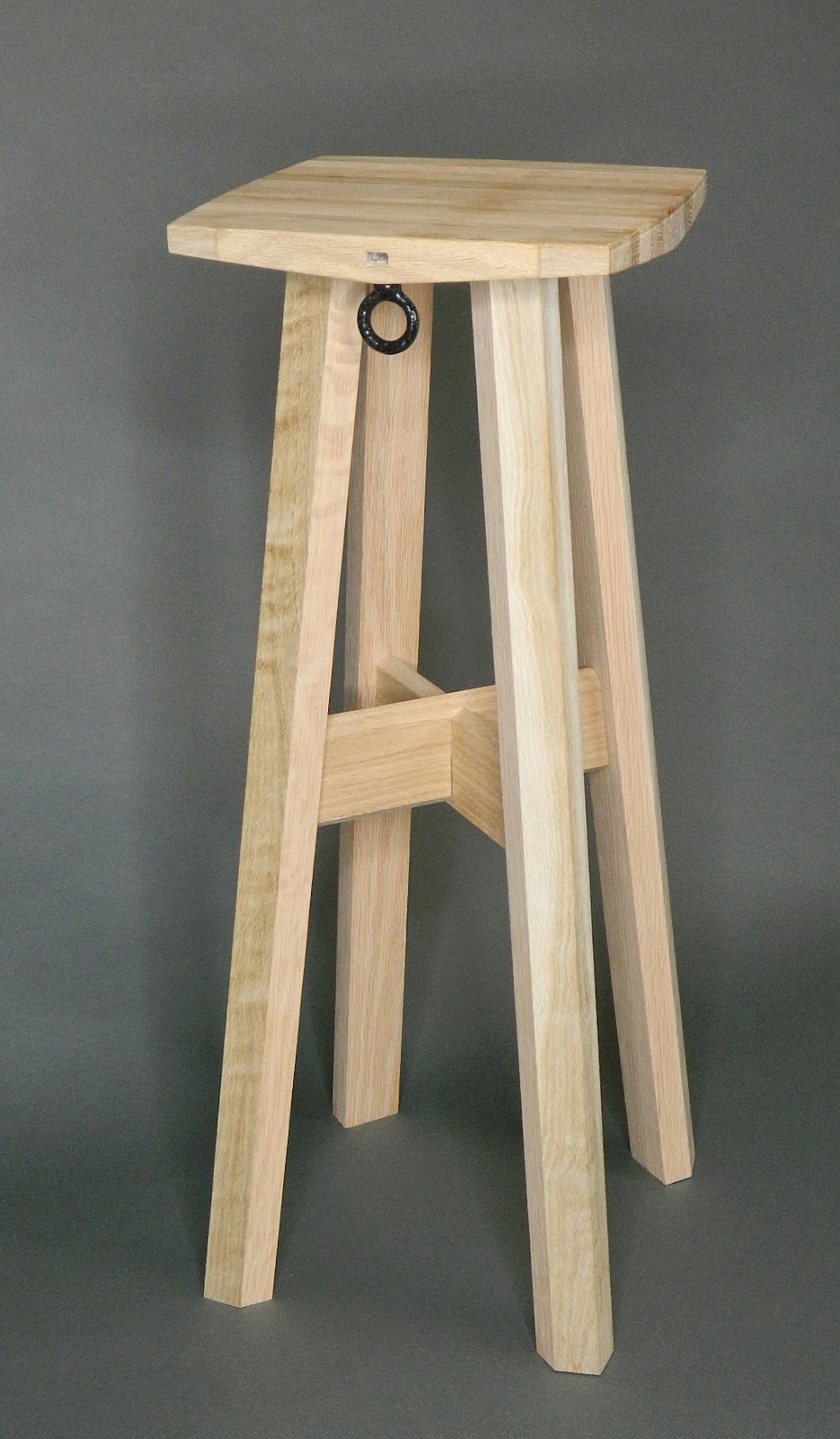
All tiny tables are 24" tall and have a top that is 9" x 9". Mainly to keep costs low, and provide an interesting category of furniture to design for,  All students will confine their designs to these dimensions.  There are 3 other tiny table examples with links to them below. 

A tiny table is intended to stand next to a desk by your chair and provide a dedicated spot to charge your phone or smart watch or rest your mug of coffee or other drink of choice. Intended to serve as a place to charge your phone, this table top could potentially have a wireless charge coil embedded or at least some clever allowance for managing charge cords.  This table could also find many other places in your home to live.  

The 4 legs are connected by crisscrossing stretchers and attaching to the 9"x 9" top.  The underside of the top is 3D carved to meet the slanting legs at 90 degrees as they approach at an angle other than 90 degrees.  While on the CNC the perimeter shape can also be cut. If a wireless charging puck is to be used, then a precise pocket for it and a slot for its power cord can also be cut on the CNC.  For this Tiny Table project all students will design, create toolpaths for, and cut out their own table top using the small CNCs.  

Underside CNC carved

For this example, the top is a square with bowed out sides. This leaves the corner angles a bit larger than 90 degrees.  

Top profile
The outer bevel on the legs were cut to the same angle.  Legs connect to the table top one of two ways depending on how the wood of the top was glued up. Figure 8 connectors can be used if the top surface is face grain and prone to expand/contract over time. If the top is quarter sawn or rift cut then tenons on the top of the legs can join into mortises cut in the angled surfaces of the top underside.  Figure 8 Fasteners

Table leg. Outer bevel matches table corners.
The top and bottom edges of the stretchers also have beveled edges that match the top corner angle.  The stretchers are offset from each other so the bevels aren't interrupted when they pass.  The first stretcher bevels pass over the opposing stretcher.  On the opposing stretcher they appear to run into/through the first.  Offsetting intersecting stretchers adds some interesting aesthetic variation and encourages doing something interesting with the top and bottom edges of the stretcher. Two diagonally opposite legs have the mortise for the tenon a little higher than the other two legs. The two stretchers are not identical. 
Top and bottom bevels matches leg bevel

Renderings in this article are from my CNC software and don't necessarily show the proper orientation of the grain in the parts.  Grain direction in the stretchers should run from tenon end to tenon end. 

This tiny table teaches students how to properly size and make mortises and tenons, as well as layout and cut a halving joint for the crossing stretchers in context. The top and potentially the legs are opportunities to show students how to glue up panels of thick wood blanks from narrow/thinner strips of wood. Reorienting the wood face grain can reduce expansion/contraction by 2/3.  

Not all projects have to look the same, but the base of each should relate aesthetically to their top.  All surfaces of every component are opportunities to add detail to. It is the continuity of details in this project that adds to the story that can be told about the design.  The story that you can tell is what makes the design more memorable and desirable. 

Don't forget about finish.  Some woods accept stain well to alter their color.  Some may look better painted. How about India ink to blacken oak or ash but leave the grain details visible?  Top finish can be oil based or lacquer based or water based or wax or French polish or whatever.  Some yellow or darken the color.  Water based and lacquer or Deft tend to go on clear.  Just don't forget that top finish.  

On this prototype a plastic coated eye hook is screwed into the bottom edge of the top to pass charge cords through so they can hang ready to use.  The threads screw into a square nut embedded into a slot on one side.  I made sure at least one end of the charge cords can fit through the eye hook center. The slot for the nut would be covered by a wood plug cut on the CNC to match the slot shape. For students a hook to hang a purse or backpack onto might be a good addition to this project. 

See Tiny Table 2, Tiny Table 3, and Tiny Table 4 for a few alternative variations.

Some related educational articles:

Tiny Table 2.

Tiny Table 3.

Tiny Table 4.

Joinery box.  Not about a box.

The Lathe.

Learning Actual Project Costs.

Material Sample Blocks.

Making Projects vs. Making Samples.

Tool Names and Functions.

Woodworking Education: Tiny Table 2

Creative variation opportunities. 

Design students usually strive to be and are encouraged to be unique.   Making the same exact thing as your classmates, just to learn a bit of woodworking, is potentially boring.  With permission to make this final beginning workshop project an expression of their own creativity, a few requirements have to be set so they don't get carried away and miss what they should be learning. 

Tiny Table 2 is simply an aesthetic alternative to Tiny Table 1. Another example for the final beginning workshop project.  All parts differ, but both tables use the same joinery connections between legs and stretchers. Table 2 won't have leg top tenons piercing the top, but instead use one of two standard hardware strategies to attach table tops.  Students are also encouraged to "sign" their work, and the 4DT initials (below) shows one way/place to sign it. Fill the engraved initials with tinted resin then sand flat to the table top. Any scratches that appear in the resin from sanding will disappear once a finish is applied to the top.  

Top Profile

Underside 3D Shape

The stretchers in Table 2 run around from leg to leg rather than cross in the middle.  They attach near the top of the legs, but then have stretchers attached in their middle that cross (half lap) under the table top.  This is where connections to the top are made. These middle stretchers may French dovetail into the side stretchers. When connected to the top they transfer load to the side stretchers.  The legs take the load from the side stretchers to the floor. 

This table is another example of detail continuity throughout the design. The leg profiles visually extend the corner shape of the top down to the floor.  More specific details can be realized and added after the table parts are rough assembled. How the feet meet the floor is one area for consideration. 

Leg cross section.

The outer stretchers have a shallow cove that matches the inward curve of the table top sides.  Bottom and top edges of the outer stretchers are rounded like the underside edge of the top. 

Bottom and Top Edge Curves

Face Contour Matches Top Edge

Even though the assembled dimensions of all tables will be the same, and all will include mortise and tenon joinery, half lap joinery, and potentially more depending on their design, the range of solutions is practically infinite.  Both also demonstrate how to glue up material for their tops, and process the glued up blank down to a finished table top.  The final step for all tables is to sand parts smooth and apply a durable finish. This is best done before assembly but requires taping off any area that is part of the joints between parts.  Then comes glue-up/assembly.  It is the continuity of details that adds to the story you can tell about this table.  That story is what makes the design memorable and desirable.    

Some related educational projects:

Tiny Table 1.

Tiny Table 3.

Tiny Table 4.

Making Samples vs Making Projects

The Joinery Box.  Not About a Box.

The Lathe.

Material Sample Blocks.

Tool Names and Functions.

Determining Actual Project Costs