Search This Blog

Showing posts with label mortise and tenon joints. Show all posts

Tuesday, April 12, 2022

Woodworking Education: Tiny Table 1

Tiny Table 1

A Lesson in Wood Fabrication and Joinery

Teaching furniture design to college students who have no prior experience with fabrication techniques requires showing them examples of how to turn raw materials into finished furniture. 

Tiny Table is a final project for the beginning workshop class to teach them common wood table joinery. It also shows them all the steps needed to get from raw wood to finished parts that make up the table.  It is best to have students all work though the required steps to build their own version. It gives them motivation to do a nice job, and they end up with something they can use. In the process of making their own they also learn about the tools they will be using.  That and the typical joinery used as well as how to make the required joints.

The project is also a lesson about and demonstration showing the continuity of details possible.

All tiny tables are 24" tall and have a top that is 9" x 9". Mainly to keep costs low, and provide an interesting category of furniture to design for,  All students will confine their designs to these dimensions.  There are 3 other tiny table examples with links to them below. 

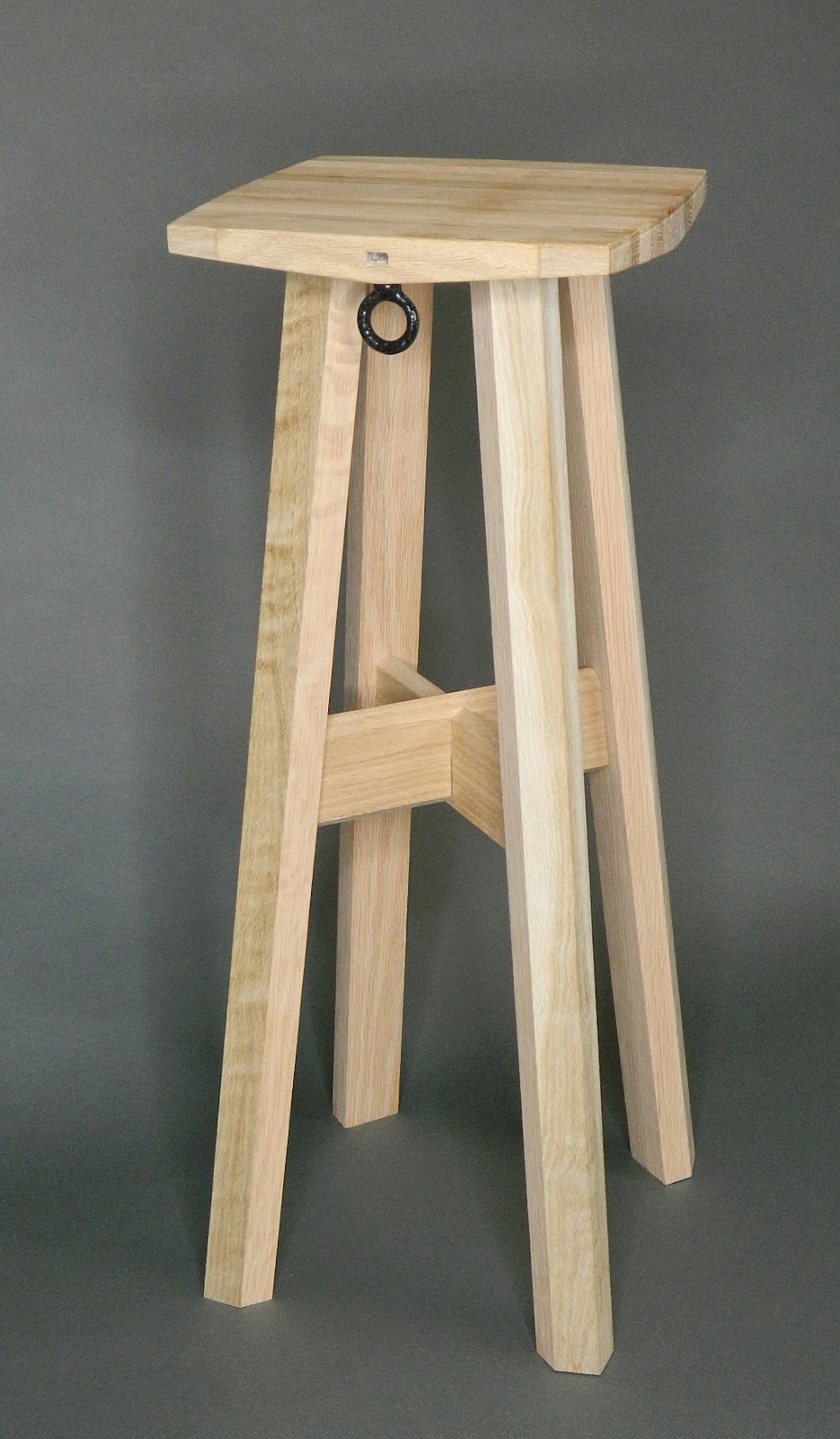
A tiny table is intended to stand next to a desk by your chair and provide a dedicated spot to charge your phone or smart watch or rest your mug of coffee or other drink of choice. Intended to serve as a place to charge your phone, this table top could potentially have a wireless charge coil embedded or at least some clever allowance for managing charge cords.  This table could also find many other places in your home to live.  

The 4 legs are connected by crisscrossing stretchers and attaching to the 9"x 9" top.  The underside of the top is 3D carved to meet the slanting legs at 90 degrees as they approach at an angle other than 90 degrees.  While on the CNC the perimeter shape can also be cut. If a wireless charging puck is to be used, then a precise pocket for it and a slot for its power cord can also be cut on the CNC.  For this Tiny Table project all students will design, create toolpaths for, and cut out their own table top using the small CNCs.  

Underside CNC carved

For this example, the top is a square with bowed out sides. This leaves the corner angles a bit larger than 90 degrees.  

Top profile
The outer bevel on the legs were cut to the same angle.  Legs connect to the table top one of two ways depending on how the wood of the top was glued up. Figure 8 connectors can be used if the top surface is face grain and prone to expand/contract over time. If the top is quarter sawn or rift cut then tenons on the top of the legs can join into mortises cut in the angled surfaces of the top underside.  Figure 8 Fasteners

Table leg. Outer bevel matches table corners.
The top and bottom edges of the stretchers also have beveled edges that match the top corner angle.  The stretchers are offset from each other so the bevels aren't interrupted when they pass.  The first stretcher bevels pass over the opposing stretcher.  On the opposing stretcher they appear to run into/through the first.  Offsetting intersecting stretchers adds some interesting aesthetic variation and encourages doing something interesting with the top and bottom edges of the stretcher. Two diagonally opposite legs have the mortise for the tenon a little higher than the other two legs. The two stretchers are not identical. 
Top and bottom bevels matches leg bevel

Renderings in this article are from my CNC software and don't necessarily show the proper orientation of the grain in the parts.  Grain direction in the stretchers should run from tenon end to tenon end. 

This tiny table teaches students how to properly size and make mortises and tenons, as well as layout and cut a halving joint for the crossing stretchers in context. The top and potentially the legs are opportunities to show students how to glue up panels of thick wood blanks from narrow/thinner strips of wood. Reorienting the wood face grain can reduce expansion/contraction by 2/3.  

Not all projects have to look the same, but the base of each should relate aesthetically to their top.  All surfaces of every component are opportunities to add detail to. It is the continuity of details in this project that adds to the story that can be told about the design.  The story that you can tell is what makes the design more memorable and desirable. 

Don't forget about finish.  Some woods accept stain well to alter their color.  Some may look better painted. How about India ink to blacken oak or ash but leave the grain details visible?  Top finish can be oil based or lacquer based or water based or wax or French polish or whatever.  Some yellow or darken the color.  Water based and lacquer or Deft tend to go on clear.  Just don't forget that top finish.  

On this prototype a plastic coated eye hook is screwed into the bottom edge of the top to pass charge cords through so they can hang ready to use.  The threads screw into a square nut embedded into a slot on one side.  I made sure at least one end of the charge cords can fit through the eye hook center. The slot for the nut would be covered by a wood plug cut on the CNC to match the slot shape. For students a hook to hang a purse or backpack onto might be a good addition to this project. 

See Tiny Table 2, Tiny Table 3, and Tiny Table 4 for a few alternative variations.

Some related educational articles:

Tiny Table 2.

Tiny Table 3.

Tiny Table 4.

Joinery box.  Not about a box.

The Lathe.

Learning Actual Project Costs.

Material Sample Blocks.

Making Projects vs. Making Samples.

Tool Names and Functions.

Woodworking Education: Tiny Table 4

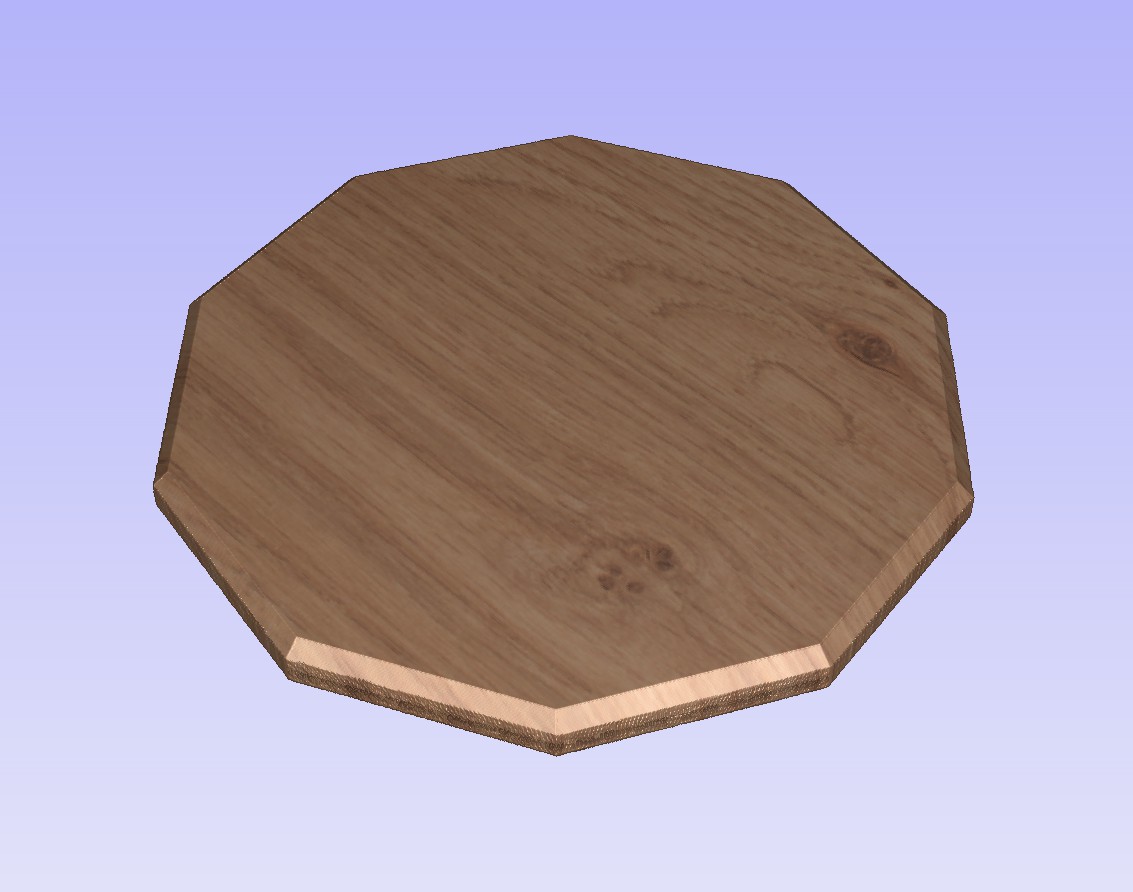
Tiny Table 4 is another example for the final beginning workshop class project.  This charging table example is also 24 inches tall with a 9" diameter decagon (ten sided) top. It is also another example of detail continuity throughout the design.  These four Tiny Table projects are made as initial diverse examples to show and inspire the students. The creative projects designed and built by students of this class will become the new examples to show and inspire and challenge the next class of students. Rather than have the next class start from scratch with this project each class year sees a new baseline to challenge them to improve upon.  

Top face of decagon top.
The top started out 1.157" thick.  The top side has a 45 degree chamfer around the edge to help the edge look thinner.  The chamfer also catches light differently than the top, adding visual complexity/interest to the simple top. 

Decagon Top. Bottom view.
The bottom face of the top is carved to emphasize the ten sides as well as reduce the visual thickness of the wood slab. 

This project teaches how to chamfer the perimeter edge of the table top.  It also teaches a simple way to make an interesting 3D shape on the bottom face of the table top using the CNC software.   With the CNC software installed in the college computer lab, students are assigned to design their own 9" maximum table top, then save the toolpaths for it to cut on the small CNCs.    

There are 5 legs. Five legs provide the most efficient and stable footprint for the nearly circular top. All legs start at 3/4" thick.  The legs taper inward to just a bit thicker than .5" at the top inside corner. 

Beveled Edge and Tapered Thickness

The outer edge of the legs has a double chamfer that matches the corners of the top above them. The top edge of the legs is shaped to echo the carved underside of the top above them.

Top End Profile
The leg elevation view tapers down to 1.25" wide at the bottom. 

One of 5 legs.
The legs are a complex shape and require several processes to produce. This project teaches the logical sequence and tools used for the steps needed to produce it:
 
1. While the board is still a rectangle, cut double bevels on the straight outer edges of the legs. Use the table saw with blade tilted 18 degrees.
2. Cut out duplicate parts (5 legs) using a template. Use double sided tape or a few spots of hot melt glue to attach the template to the leg board.  Rough cut within 1/16" or so with the bandsaw and use a flush cut pattern bit on the router table to trim flush to the template.
3. Layout and cut mortises.  Use the mortising machine or the drill press with a Forstner bit followed by chisels to clean out the mortise. Or potentially start with a slot cut using an end mill in the router table followed by some chisel work to square the mortise.  A CNC configured for clamping boards on edge could also be used.
4. Taper both sides of the leg thickness from outside to inside edges.  Use a sled with shims to tilt the leg slightly (2.7 degrees) and run through a planer or the horizontal drum sander. Repeat on the other side but shim the board 5.4 degrees. Shims can be cut using the bandsaw. The digital angle gauge can check the shimmed angle. Hot glue in place before running through either machine. 
 
Short 1/2" thick stretchers are mortised into the inside edge of the legs.  The inner end of the stretchers dovetail into one face of the 5 sided center hub sections. Top and bottom edges of the stretchers have a small double 18 degree bevel to perpetuate the table top corner angle detail.
Top Stretcher Dovetail End

Top Stretcher Tenon End
There are two center 5 sided hub sections.  One is 2" tall underneath and connected to the top. The second is 3" tall and roughly halfway down the legs. The hubs connect all the legs together. Stretchers from the legs dovetail into these hubs.  Exposed ends of the hub sections are shaped to a shallow peak to contribute to the overall design aesthetic. This project teaches how to make a 5 sided block, and how to cut dovetail slots perfectly centered on the sides of a 5 sided block.
Top center hub.
There are 3 other Tiny Table examples that along with this one will show students the level of detail and range of creativity they are expected to achieve. The continuity of details in this project add to the story that can be told about it. It is the story about the table details more than a quick glance at it that make it memorable and more desirable.   

More related educational projects are here: